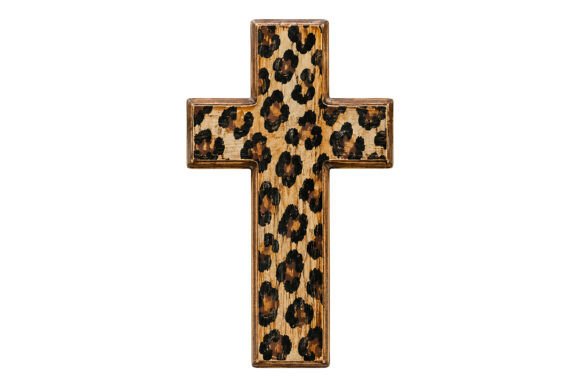
Leopard Cross Clipart
A Designer’s First Glance: Bold, Balanced, and Unexpectedly Versatile
When Leopard Cross Clipart landed in my inbox, I paused—not because it screamed for attention, but because it settled into the frame with quiet confidence. It’s not a roaring animal motif or a heavy religious symbol; it’s a stylized cross overlaid with subtle leopard print texture, clean-lined and centered. The shape is symmetrical but not stiff—there’s rhythm in the negative space, and just enough organic variation in the pattern to avoid looking digital or flat. Right away, I pictured it on a heavyweight organic cotton tote bag for a boutique launch: earthy, intentional, quietly confident. That’s the mood it carries—spiritual without solemnity, wild without chaos, modern without trend-chasing.
Where This Design Truly Shines (and Why)
Leopard Cross Clipart works best where contrast and character matter most. I stitched it onto a charcoal heather sweatshirt for a small-batch holiday collection—and the result surprised even me. The cross held its shape crisply, while the leopard texture added tactile depth without overwhelming the garment. It performed equally well as an embroidered patch on denim aprons for a local café, and as a subtle chest accent on baby onesies (using soft pastel thread on ivory fabric). Its balanced proportions make it ideal for T-Shirt Designs that need to read clearly at arm’s length but still reward closer inspection.
For Etsy sellers and craft business owners, this design bridges two strong markets: faith-based personalization and nature-inspired apparel. Customers respond well to that duality—it feels like a choice, not a compromise. I’ve seen similar motifs sell consistently as personalized gifts (think baptismal keepsakes or graduation tees), especially when paired with minimalist embroidery layouts and quality stabilizer. As a digital embroidery file, it holds up across formats: no tiny floating elements, no over-stitched corners, and no fragile stems or threads that vanish in fill stitch.
Real-World Stitching Notes You’ll Want Before Hooping
Here’s what I learned stitching Leopard Cross Clipart across five fabric types and three hoop sizes:
- On textured fabrics (like terry cloth towels or bouclé sweatshirts), reduce stitch density slightly and use medium-cutaway stabilizer—the leopard texture stays legible, but dense fills can flatten the surface too much.
- On thin or stretchy fabrics (ribbed knits, lightweight jersey), skip the satin stitch outline unless you’re adding a backing layer—opt instead for a tight running stitch border to prevent puckering.
- On dark fabric, test thread colors before committing: warm charcoal or deep olive reads richer than black, and lets the leopard pattern breathe. On light fabric, a matte black thread gives sharper definition than glossy poly.
- For curved surfaces (caps, beanies), keep the design under 3.5" wide—any larger, and the cross arms start to distort near the seams. It’s not built for full-coverage cap fronts, but it’s perfect for side-embroidered snapbacks.
What This Design Adds (and Doesn’t Add) to Your Finished Product
Leopard Cross Clipart elevates handmade presentation without demanding perfection from the maker. It doesn’t require flawless tension control or micro-hooping skills—but it *does* reward thoughtful execution. When stitched cleanly, it signals intentionality: customers notice the evenness of the cross arms, the consistency of the leopard repeat, the absence of stray jump stitches. That builds trust, especially for small shop products sold online without physical handling.
It also strengthens brand consistency. Whether you’re designing for a wellness studio, a faith-rooted lifestyle brand, or a gender-neutral baby line, Leopard Cross Clipart adapts without diluting your voice. And unlike overly literal motifs, it avoids dating quickly—no seasonal clichés, no dated fonts, no forced trends. As a holiday embroidery option, it reads as meaningful rather than thematic, making it reusable year after year.
Smart Next Steps Before You Stitch or Sell
Before using Leopard Cross Clipart in any commercial embroidery project—or listing it as part of your own digital product bundle—do these five things:
- Test it on scrap fabric matching your final project’s weight and stretch. Pay special attention to how the leopard texture renders in fill stitch versus satin stitch.
- Check thread color contrast in both natural and artificial light—some blends look identical indoors but separate beautifully in daylight.
- Review stitch density: if it feels heavy on your machine, trim 5–7% density in editing software (don’t just slow the machine down).
- Confirm hoop size compatibility. Leopard Cross Clipart fits comfortably in a 4x4 hoop, but verify whether your version includes alternate sizes or simplified variants for smaller hoops.
- Double-check licensing terms. If you plan to sell finished embroidered items (like custom apparel or embroidered patches), ensure the license permits commercial use. If you’re reselling the embroidery file itself, confirm whether redistribution or derivative creation is allowed.
A Final Thought for Crafters and Creative Entrepreneurs
Leopard Cross Clipart isn’t flashy—but it’s dependable. In a market flooded with overdesigned clipart and generic symbols, it stands out by doing less, but doing it with clarity and care. It works for baby embroidery and boutique sweatshirt embroidery alike because it respects the wearer’s story instead of shouting over it. Whether you’re building a craft business, prepping for a holiday craft fair, or creating personalized gifts for friends, this design earns its place in your library—not as filler, but as a quietly powerful tool. Just remember: great embroidery starts long before the needle moves. Test it. Touch it. See it on the real thing. Then let Leopard Cross Clipart do what it does best—speak with subtlety, stitch with strength, and stay true to your work.